During the winter of 2003, Frank Romano attended the Golf Foundation's annual meeting to see Herb Kohler accept an award for his contributions to the golf industry. Kohler had turned the purchase of toilets and bathrooms into something elegant and, in doing so, had become the country's toilet magnate and made his resort and golf courses in Kohler the visible vehicle for the brand. Most importantly, he had made a commitment to tournament golf which would open the door for years of international competitions in Wisconsin.
Frank Romano had become friends with Mr. Kohler but was unaware that Kohler would be making an announcement at this event that Romano wasn't yet ready for.
Kohler stood at the podium and made a brief, gracious acceptance speech, making a few comments about the economic state of the industry. Then he said; "I'd like to introduce Frank Romano. He's buying the Country Club of Wisconsin and he'll do a great job."
Romano's thought at the time was, "He just totally blew my confidentiality because the deal was still in the final stages. He was OK with it because no one was going to sue him!"
The following Monday, several calls from people interested in becoming investors calmed his nerves and in a few short months, CCW opened for the 2003 season as Fire Ridge and became the second golf course in the area (Scenic View) with the Romano name on it.
"I also got some calls from golfers who wanted to know what I was going to do about the 18th hole", Romano said. "and some pointed advice regarding whether or not golfers would be allowed on the golf course in denim."
The Country Club of Wisconsin had an auspicious beginning when it opened in 1994 and an equally interesting demise as the economics of the industry rang the bell on many courses beginning in 2000. Naming a new golf course the Country Club of Wisconsin conveys some swagger and CCW ultimately lived up to its name. It was a championship course.
In the early 90s, the golf boom was so vigorous that the National Golf Foundation claimed that the industry could have supported a new course opening every day. That held true for awhile but 2000 was the tipping point. That year more courses closed than opened.
Kerry Mattingly and Greg Kuehn of Treetops Design, in Grafton, were there from the outset. According to Mattingly, they got some enthusiastic support from Cedarburg businessman Bill Wernicke, Sr. in the late 80s to embark on a new direction with their landscape design business. An avid, accomplished golfer, Wernicke thought that their landscaping style would be a good fit for designing golf courses and they took his advice. They began attending trainings around the country with some of the well-known names in the industry.
They began looking at property and soon found property right in their own back yard. The 217 acre site which became CCW was less than a mile away, west of their Town of Grafton offices. An initial investor walked away but their attraction to the property was strong. They began what would become a labor of love and walked the acreage many times; talking and watching the golf course emerge from their ideas about what a golf course should offer. The site of the future (as yet undesigned) clubhouse dictated the locations for holes 1, 9, 10 and 18 as an out and back routing was essential.
They made a trip to Scotland in 1990 and the old links courses which they played reinforced their evolving philosophy that told them that "less is more." They were becoming minimalists.
The CCW property fit their "eye" even more harmoniously when they returned and their passion for the property pushed them in the direction of finding buyers who would subscribe to their emerging plan. The property owners were willing to sell and Mattingly and Kuehn redoubled their efforts. They had a design plan and hadn't yet secured a contract. They were motivated.
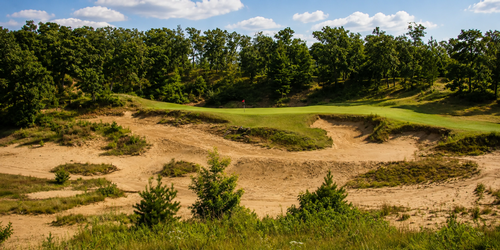
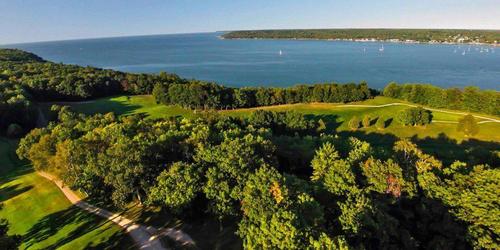
The land was a gorgeous combination of rolling meadows, woods and wetlands. The wetlands would be of interest to the DNR and, perhaps, the Army Corps of Engineers.
Locations for green complexes came first and possibilities for teeing areas followed. With their self-imposed out/back mandate, there were really only two choices given the property; head north and route the first nine holes clockwise or go west and use a counter-clockwise routing: or vice versa. The routing which ultimately prevailed was that which ended with the present finishing hole; the always-controversial 18th.
In the spring of 1992 Greg and Kerry had secured their principals. Edgehill Consultants and the Wellington Investments Group had joined forces with Treetops and after five months of working with the Town of Grafton Planning Commission and the Town of Grafton Board of Supervisors, the project was "blessed".
Ground was broken in the fall of 1992.